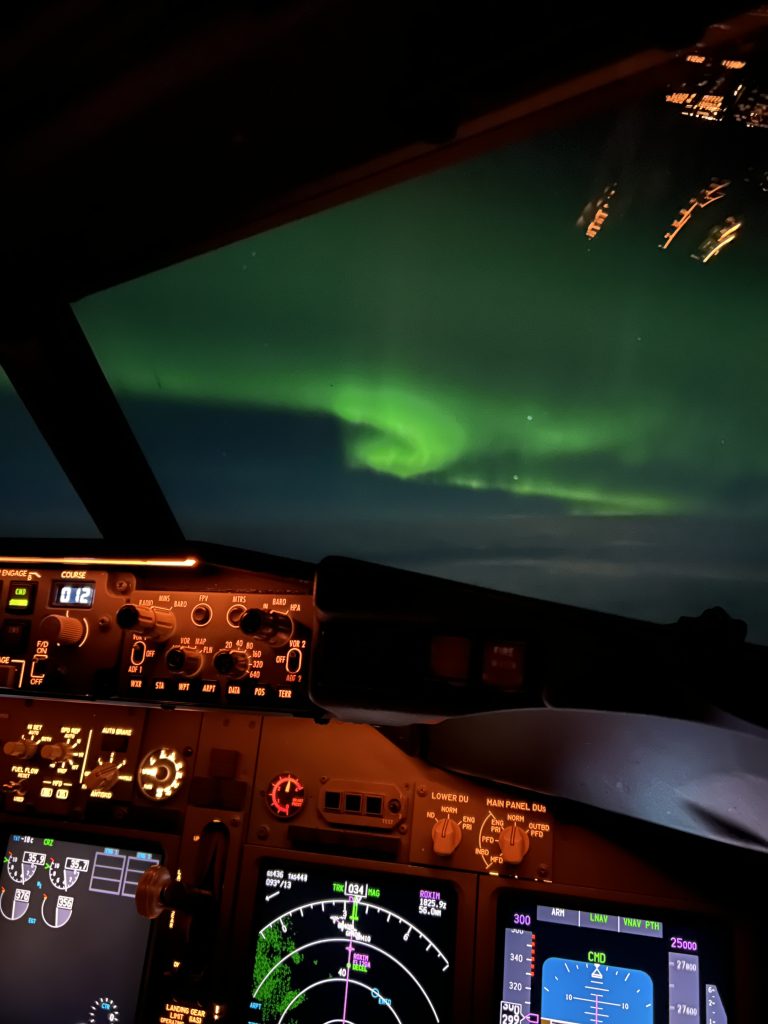
Monday 3rd July 2023 to Sunday 16th July 2023. It’s been a couple of busy weeks but by no means has it been any less enjoyable, in fact it’s potentially been one of the best weeks I’ve had in my flying career to date, as I am now type rated on the Boeing 737-800 for Ryanair! To say that out loud is truly phenomenal and I never thought when I started my journey to get me where I am, I would actually be able to say those words out loud. I look back at the light aircraft I was flying and being so gutted when the weather was bad – but now we’re quite literally taking off when the weather is that bad or even worse! I’ve had my final block of 4 sims and one sim completing circuits ready for my base training which should be coming soon!
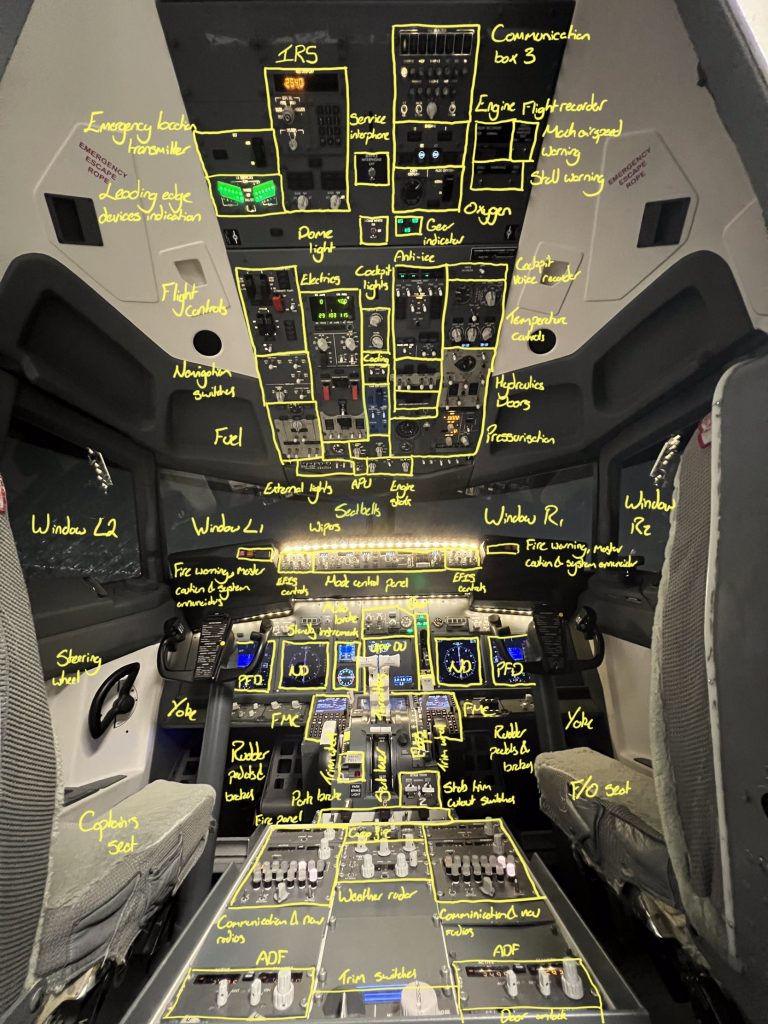
I’m aware I post photos of myself in the Boeing 737 cockpit, but don’t explain what it actually is behind me. I’ve seen this been done by other people on social media and thought I’d do my own version where I annotate what each part of the flight deck corresponds to, so you can have a rough idea the number of systems we have onboard that need to be monitored.
Tuesday 4th July 2023 – Low Visibility Initial Training & PBN Training
This lesson was amazing as it was take-off and landing followed by more take-off’s and landings or go-arounds when the weather wasn’t good enough to land. This lesson was training us ready for CAT III ILS approaches which means we can land when the visibility is 175m or more and 50ft radio altitude or more. Currently, Ryanair has 200m visibility restriction so when I start flying on the line, I need to adhere to the 200m rule, but once every Ryanair pilot is qualified in the sim to 175m visibility, this will come into force. We were also taking off in 125m visibility which means we can see only 6 runway centreline lights or 2 edge lights so that shows how little visibility we need to take-off and land. It was great fun though, and seeing the ground only at 50ft before landing is both exhilarating and scary at the same time! The second part of the lesson we looked at RNP approaches and the dangers of setting the wrong QNH pressure setting for the approach – this could mean we’re too high or too low and not necessarily realise this. This happened to Norwegian Air Sweden recently in the summer of 2022 where there was miscommunication between the Paris Charles de Gaulle Airport controller and the EasyJet flight and “the minimum radio-altimeter height was recorded at 6 ft above the ground, at 0.8 NM from the runway threshold”. This shows how active we need to be when in the pilot monitoring role and paying attention to what’s going on with the aircraft and what’s going on around us.
Wednesday 5th July 2023 – FFS 5
We began looking at engine failures at V1 at our maximum take-off weight of 79,900kg and flying special engine out SID’s. For Stansted and Dublin as an example, if we lose an engine on take-off we climb straight ahead to at least 3,000ft and enter a hold, but in some places due to terrain, this isn’t possible. We came out of Prestwick on runway 12 and flew the special engine out SID. We then came back for a one engine ILS approach and go-around then to land afterwards. We then repeated again and managed to get the engine to relight this time. Then we had a simulated jammed stabiliser so weren’t able to trim the aircraft – this wasn’t a huge deal but after a while felt a dull ache in my arms from holding the controls, it also shows how important it is to rim the aircraft. After the V/S NPA approach we then reset the aircraft but had loss of both hydraulic A and B so were only able to control the aircraft by the force that we put in. Normally, the hydraulics make the flight controls light enough for us to make an input an the plane responds accordingly, but with a loss of both hydraulic system A and B its only the mechanical connection we have to fly the plane. Airbus on the other hand works only by fly-by-wire so if in an Airbus and to lose all hydraulics, I don’t know what they’d be able to do! Finally we looked at manual flying and flying with an engine failure below 1,000ft in VMC conditions and continuing to land. To complete the session we repositioned to Salzburg and looked at the go around from runway 15 and the engine out procedure with an engine failure at V for Salzburg.
Thursday 6th July 2023 – FFS 6
Our final simulator session before our licence skills test tomorrow, and this was run pretty much the same as it would be – almost like our mock. We began with a transit setup which on the line has to be 25 minutes and we weren’t far off this time. We then took off with 34kts of crosswind, while in our climb out, we had a source off non-normal and when we started the APU to get another source of electrical power, we had an APU fire so once this was dealt with, we only had one source of electrical power and had just had a fire so declared a mayday and returned to our departure airport, Dublin. This was done via a RNP VNAV, circle to land approach where we had a go around on finals. We then looked at raw data ILS approaches including go-arounds. We were then repositioned for take-off and had an engine failure after V1 and this put us into the single-engine approaches and go-around. We completed the lesson with another engine failure, but this time before V1 and leading to a passenger evacuation. When myself and Stepan swapped over, there was no need to complete the transit setup for a second time so went straight into the air work and again, this went well – hopefully it’ll be enough for our LST tomorrow.
Friday 7th July 2023 – Licence Skills Test
Arguable the most important day to date in my flying career as this exam would see me type rated on the Boeing 737-800 and thus able to carry 189 passengers plus crew, take off and land in low visibility operations and handle the aircraft safely for any non-normal operations. The sim would last 5 hours in total, plus an hour and a half briefing before, and an hour debrief afterwards so it was going to be long. Myself and Stepan met at the hotel I was staying at the night before in the morning to consolidate everything we’d been through right from fixed base sim 1 through to the lesson we had yesterday – it’s safe to say we were both nervous and equally wanted to do the best not only for ourselves but for each other too. We arrived at the training centre and went in for our briefing at 14:10 local time which took us through what was going to happen in our exam, we the examiner expects of us and what we can expect of our examiner. We also worked out all of our performance on the ground too, this safe sim time so we can get more done and also fully briefed for each of the approaches we would be doing, again saves time. This way in the air we can get more done and only do a simplified brief.
We walked to the sim and Stepan was pilot flying first and I would be pilot monitoring first. Stepan completed the majority of the transit setup, we completed our before task-off brief and taxied to the runway for a low visibility take off. We took off and in the climb had a non-normal which required us to divert back to Dublin for a VNAV RNP 34 circle to land 16 which went well – better than we had practiced over the last couple of sims. We then took off with an engine failure after V1 for our single engine air work as well as approach and go-around. We then repositioned for another 2 approaches, this time for CAT III minima at the new Ryanair standard of 175m visibility – the first led to a go-around and the second was to a landing. Given I was pilot monitoring in the Captain’s seat, this was my first landing of the day, albeit an autoland! We then set-up for a raw data approach and this was to a landing. Finally, Stepan was repositioned on the runway for an engine fire before V1 and subsequent evacuation and that was the end of first half of the session. As we came out of the sim for our break, the first words I said to Stepan was “you, my friend, are on fucking fire today” and that wasn’t an exaggeration. Stepan was proper on the ball, all of his flying was pinpoint perfect and knowing he was going to be my PM when he was in this form settled me down ready for my turn as pilot flying. My turn in the sim and it was the same as Stepan pilot flying, however, this time there wasn’t the need for the transit setup. Again, all my approaches went well, not exceptional and I wasn’t over the moon with how they went but they were within the limits so that’s all that matters, it’s just my own point of view I wished they went a little better. After the evacuation, the examiner said the words I’d been longing to hear for a long time, “congratulations gentlemen, I have the pleasure in saying you’ve passed”. The smiles on myself and Stepan’s faces could’ve lit up a whole city after dark, and I think our shoulders both dropped a few inches with the weight being lifted off them!

Saturday 15th July 2023 – Preliminary Simulator Circuit Training (PSCT)
Back in the simulator again after a week off and it was great to be back flying again! We completed circuits in the aircraft to simulate what it’s going to be like for our base training to come – the first time we get to fly the Boeing 737-800! We completed a total of 8 circuits which went as follows:
- Take-off with flap 5, visual circuit with a left-hand orbit, flap 30 touch and go with 10kts headwind,
- Take-off with flap 15, visual circuit, flap 30 touch and go with 10kts headwind,
- Take-off with flap 15, visual circuit, flap 30 go-around at 500ft with 10kts headwind,
- Take-off with flap 15, visual circuit, flap 30 touch and go with 10kts right crosswind,
- Take-off with flap 15, visual circuit, flap 30 touch and go with 10kts right crosswind,
- Take-off with flap 15, visual circuit, flap 30 touch and go with 10kts left crosswind,
- Take-off with flap 15, visual circuit, flap 30 touch and go with 10kts left crosswind,
- Take-off with flap 15, visual circuit, flap 40 full stop landing with 10kts left crosswind.
This was very intense I won’t lie! It was an hour of solid manual flying, constantly scanning, completing checks, configuring for one phase of flight then reconfiguring for the next, but was it good fun! In a 737 it takes approximately 6 minutes to complete a circuit, in which time we’re retracing the flaps from 15 to 5 and accelerating, completing the after take-off checklist, briefing what the next approach will be, descent and approach checklist, timing the circuit, configuring for the approach, intercepting the final approach path, maintaining the correct vertical picture and landing the aircraft, and then competing it all again. My circuits did start a little ‘wobbly’ and I didn’t think they were great at all, but they improved with help from the instructor in the seat next to me and by the end, they were so much better than at the start of the lesson. So with that good news, the next step is to take the actual aircraft up for circuits!
That bring another blog to a close and another important milestone reached and passed which I am over the moon with. The next step is for me to complete my base training which is going up in the Boeing 737-800 at East Midlands airport and completing the same 8 circuits as I completed in the sim, of course this time, we’re given whatever wind Mother Nature wants to give us and have to deal with real-world conditions for the first time in the aircraft so plenty more to deal with. Until next time where I tell you all about this incredible milestone coming up, take care and I’ll catch you all real soon!