
Tuesday 01st October 2024 to Tuesday 31st December 2024. A whopping total of 324 sectors flown for Ryanair which equates to a grand total of 1,008 hours and 46 minutes on the Boeing 737 family and my total hours of 828 hours 16 minutes across all aircraft types which including simulators rises to 1,184 hours and 16 minutes! Throughout my flying career to date, this means I’ve flown a total of at least 275,329 nautical miles which equates to 1.3 times the distance of the way to the moon – we’re still working on getting home again! This same distance is 51 times the width of Russia, or 16.9% of the way around Saturn’s rings. Firstly, a very happy new year to you all! But before we look forwards of what’s to come in 2025, let’s take a moment to look back at the last 3 months ion flying for Ryanair U.K. out of London Stansted. October, November and December have all been incredible, not only in the flight deck but also in my personal life too that I’ll share with you later on. However, in the meantime, please sit back, relax and enjoy my latest blog!
October begun with some annual leave which after a busy summer schedule – albeit it quiet compared to other years speaking to other captains – it felt nice to not worry about flying for a week, however my first day back after my annual leave was my birthday where I was greeted with a 04:05am wake-up to fly a 4 sector day to Torp and Kosice. The day went well and was great to celebrate my birthday in the evening with my mum, dad and grandma making the journey up to Stansted to be with me for a birthday dinner. Then, to top things off, I was in bed nice and early for another 04:05am wake up the following day! Although it may sound like I’m moaning, I’m most certainly not and I have had worse birthdays than this in the past!
October also saw me flying up to Edinburgh and a new destination in Milan, down to the Canaries, over to Greece, Tirana, Morocco (Tangier, Marrakesh & Agadir). I’m often asked if I prefer flying to somewhere new or the same destinations and the honest answer is that it varies! Flying into Milan was really picturesque and the approach and landing was great, however on the ground it was manic! There was so many aircraft all trying to speak to ATC and them trying to reply back, not to mention some confusion over our callsign that didn’t help! [Ryanair DAC (the ‘main’ side of Ryanair) has the callsign “Ryanair XXX” however in Ryanair UK we have the callsign “Bluemax XXX”] ATC kept asking us questions but starting with Ryanair as opposed to the Bluemax we’re used to hearing. I don’t know how to describe it, but your brain tunes in and out of all the various callsigns. So when we hear a Bluemax callsign, our ears prick up and we know it’s for us, but by hearing Ryanair or Easy (for EasyJet) or Speedbird (for British Airways) you ‘zone-out’ so to speak as you know it’s not for you. So when ATC are trying to give us instructions but using the incorrect callsign, it makes it more difficult for us to follow along. Equally, though, it’s nice to fly to the same destinations as you slowly become used to the small nuances each place has and the way they do things. I’d never turn down going to a new destination – I’m desperate to have Salzburg appear on my roster – and I’ll never say no to going to the same place for all my 5 days on.
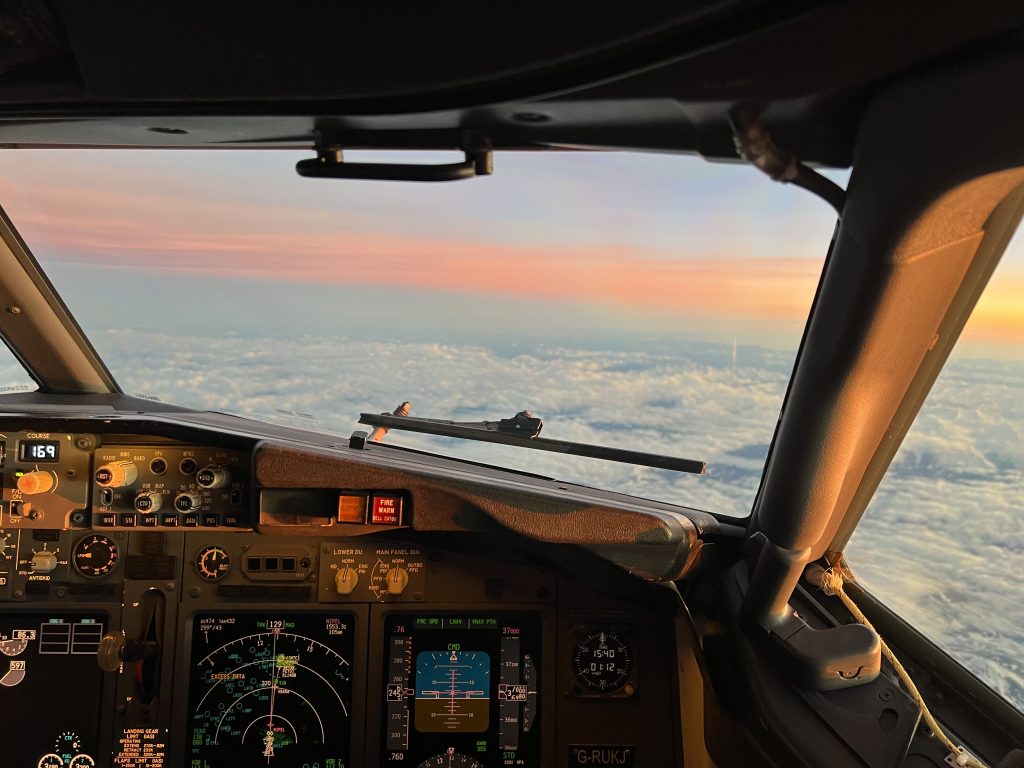
November saw me tick off one of my bucket list items – seeing the Northern Lights! For all my life, I’ve been truly fascinated by them and always wanted to see them. Many years ago, my grandparents went to Iceland and attempted to see them but were unsuccessful. Last Christmas I was on a cruise up to Norway and as far North as Tromso & Alta; we went on a northern lights excursion to see them, tried listening to the ships announcements when the bridge saw them – which included sleeping with the TV on to get these announcements! One evening, word went around that they were visible and in -16ºC temperature I was stood on the top deck in suit trousers, a shirt and a light puffy jacket and that’s it! I daren’t go back inside incase they showed themselves. I survived a couple of hours out there regularly doing star jumps and small jogs to stop me turning to ice but I was unsuccessful. The closest I got, was taking pictures of the northern lights by increasing the exposure settings on my camera and even then I counted this as a win!
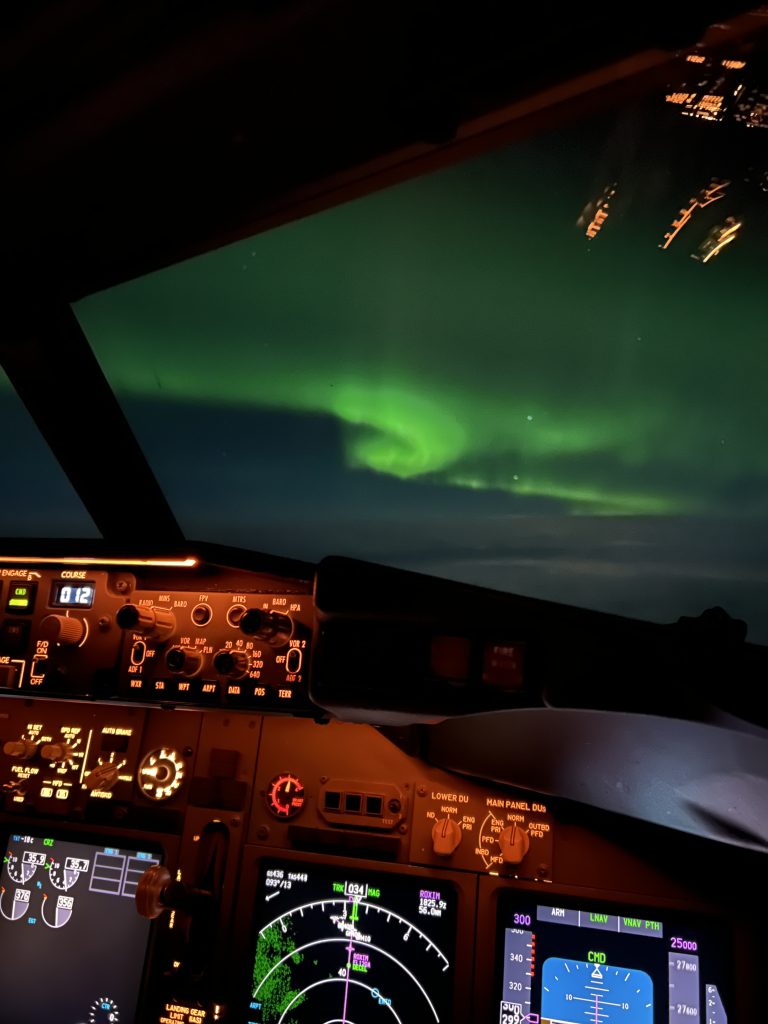
On Sunday 10th November 2024 I was flying on lates to Oslo, and in my head before departing I hoped that I may see them. Tracking North-Easterly towards Norway, I could see this grey whisp which looked like a cloud out of the window. The further we went and this ‘cloud’ wasn’t moving I made a comment to the captain that I was hoping to see the northern lights but it seemed just this one cloud. He suggested taking pictures to make sure, and that’s when they started coming out in photographs! Again, much like nearly a year prior I was happy seeing them on pictures and were so much clearer than pictures I took before. Then finally, as we started our descent, the green colours appeared to the naked eye and it was rather quite magical, and in a strange way I felt quite emotional finally seeing them out of my flight deck window. I’ve said to myself that I won’t let this be the last time I see them, and I will see them properly dancing across the sky one day!
2 days later I flew to Basel, which on paper was a really lovely shift to have, the reality turned to be something else! Before we were about to start boarding in Stansted, we had a person from the U.K. CAA turn up to inspect our boarding process and cabin crew completing their pre-flight duties and checking the safety equipment onboard. Thankfully, this was nothing to do with us in the flight deck but was a big deal for our amazing crew in the back. They needn’t have been worried in the slightest as the U.K. CAA inspection didn’t flag any findings at all which was good news. We then set off for Basel, landed and pulled onto stand. Upon reaching the stand there was 4 men in high vis looking at the exterior of the plane. There is normally a lot of ground crew helping us on a turn-around but this was unusual. I politely questioned who they were and what they were doing, and with that they showed me their ID and introduced themselves as inspectors from the French CAA completing a SAFA inspection. For those not in aviation a SAFA inspection is; “Safety Assessment of Foreign Aircraft (SAFA) is a process conducted by regulatory authorities to evaluate the safety and airworthiness of aircraft registered in foreign countries when operating within their airspace.” This is the mother of all inspections, looking at both the exterior and interior aspects of the aircraft. They noticed a small chip on one of the fan blades and wanted to check it was noted in the damages section in our tech log. While the captain went out to look at this I was quizzed inside about some of our procedures and safety equipment onboard such as the ground proximity warning system, the torches, the IRS, how we open the flight deck door in flight, where our aircraft certificates are and ensuring they’re all in date – the questions just kept on going on! The small chip on the fan blade was already noted in the tech log and we were good to depart after checking our licences, medicals and breathalysed us as crew.
Finally, the month of December, filled with festive cheer and joy! Ryanair doesn’t fly on Christmas Day unlike other airlines meaning us crew get the day off. I was working the 23rd, 24th, 26th and 27th which meant a bit of travelling up and down from my family home and back home and to work again. This included flying to Helsinki which was a new destination for me, and although we aim for a piece of tarmac with numbers on that vary in length, at the end of the day it’s still a runway! However, it was one of the most stunning approaches into Helsinki with small undulating valleys and inside the valleys fog/mist had begun to settle in them, creating an almost Christmas card esque feel to it. Although I don’t have little humans of my own or in my family, and I think this contributes to the fact it didn’t feel ‘Christmassy’ seeing this landscape did change things.
However, despite the flying it’s an achievement in my personal life that I’ve very proud of and would like to share with you all. At the beginning of December I had annual leave so myself and my partner Liv went away, and while away on holiday together I dropped to one knee and proposed after nearly 5 years together. To my delight, she said yes, and I don’t want to speak out of turn when I say this, but the pair of us are immensely proud and happy to be spending the rest of our lives with each other.

That brings me up to date with the last 3 months of flying. Looking back at 2024 as a whole in a brief recap, I started this year still in line training with only 70 sectors under my belt and this year I’ve flown 254 sectors. Although I learnt an incredible amount while at ground school, in the simulator completing my type rating and during line training, I truly believe that I’ve learnt the most in my last year of flying; gaining real-life experience, dealing with issues and problems that couldn’t have been thrown at me in the simulator or there is no set guidance written in a manual for how things are meant to be done; and this is what I love. I’ve always maintained I couldn’t be sat in an office 9-5 moving numbers from one column to another, heading into meetings and hearing cliches all day “think outside the box” “we’ll circle back to that” and “it is what it is” – that’s not for me!
I begun the year on an out of base in Alicante to finish my line training while being based out of Leeds Bradford airport. When I headed back up North, it was battling storms, being called from standby to operate flights and flying with ‘regular’ Captains for the first time which after being with a line training captain who analyses every minute detail and provides feedback was different too. I then moved to Ryanair UK and back down South to London Stansted where I’ve been since, and I’ve never been happier.
Looking forwards to 2025 and what I’d like to achieve this year. More of the same to be honest! I’m looking at getting as many hours under my belt as possible and potentially un-freezing my ATPL, if not this year then in 2026 (fingers crossed), and looking at my career pathways too – this be whether I continue working towards getting my command for Ryanair or looking ay becoming a synthetic flight instructor (SFI) and teaching in the simulators for a year/18 months. It’s unlikely I’ll be doing this in 2025, however, it’s good to start having a plan in place and something to work towards in the future.
Flight Time Limitations Discussion Item
We’ve all been there on a flight when it’s been delayed and someone says “I wonder if the crew are going to be within their hours limitations”. I have been on a Virgin Atlantic flight when this happened – a long story but before we departed we were sat on the ground for nearly 2.5 hours, I can’t remember the reason but it was something technical. Then, in flight, there was a medical emergency onboard as we crossed the Atlantic, we diverted to Goose Bay in Canada and the crew saved the persons life because of the decision and quick thinking actions they made; well done to the crew. While we had to wait for the man and his family to be unloaded as well as their luggage the crew went out of hours where we diverted to New York before continuing down to Orlando with a new crew. But this brings the questions, what are the limitations pilots can work and how does this compare to other transport industries?
In Europe, the maximum flight duty time which can be planned for the pilot to work without in-flight rest is 13 hours. However, the limits for how many hours a pilot can work in a day, week or month can be complex and depend on many factors. The amount of hours pilots can work in one day vary by their time zone acclimatisation, i.e. if they’re operating from their home base or from somewhere else, the amount of flights they are going to operate, and how many flight crew onboard – for long haul flights as they can take controlled rest. There are also restrictions on duties that have several early starts in a row or time off required following night flights. There are requirements for a fixed amount of days off during a set period, maximum flight and duty time limits for periods of 7 days, 14 days, 28 days and annually which can be seen in the example below. There are also requirements that state a minimum period of rest (normally 12 hours but can be less or more) between each day of flying.
EASA state that the total duty period to which a crew member may be assigned shall not exceed:
- 60 duty hours in any 7 consecutive days (equates to 8.57 hours a day)
- 110 duty hours in any 14 consecutive days (equates to 7.85 hours a day)
- 190 duty hours in any 28 consecutive days (equates too 6.79 hours a day), spread as evenly as practicable over that period.
Whats stated above is quite confusing I’m aware, to clarify, a duty period is defined when a pilot checks into the airport to commence their pre-flight duties to after landing once they have completed their post flight duties. In Ryanair, we report 45 minutes before departure (at the latest) and this is either at the aircraft, gate or crew room depending on the airport, and finishes 30 minutes after we’ve arrived on stand for our final flight of the day.
These times are not the same as flight duty period which covers the period from when the aircraft is under it’s own power to when the aircraft comes to a stop for the crews last flight. This is also known as block time, i.e. block to block.
However, this is the world of aviation, so it’s not those 3 points above, we also have further limitations. The total flight time of the sectors on which an individual crew member is assigned as an operating crew shall not exceed:
- 100 hours of flight time in any 28 consecutive days (equates to 3.57 hours a day)
- 900 hours of flight time in any calendar year (equates to 2.47 hours a day)
- 1,000 hours of flight time in any 12 consecutive calendar months (equates to 2.74 hours a day)
Furthermore, below is a table which sets out the normal maximum hours a crew member can work for a flight duty period, assuming the crew member is ‘acclimatised’, i.e. working from their home base. These hours can be extended through in-flight rest (i.e. having more than 2 pilots onboard) and Captains discretion, both of which I’ll describe later on.
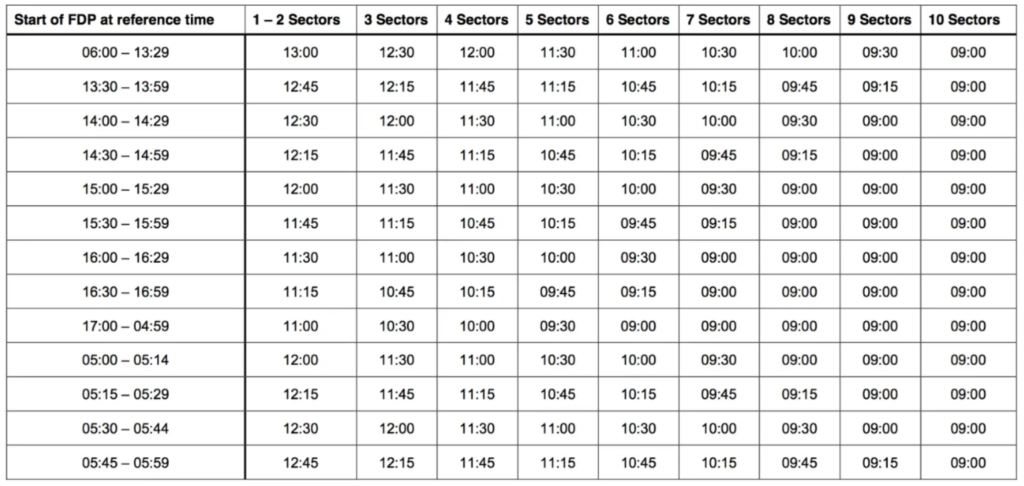
A typical days work for myself will see a report early in the morning at Leeds Bradford to fly down to the Spain, then will then fly back to Leeds and perhaps fly again to Dublin for example. The maximum flight duty period under EASA regulations for a start time of 0600 or later would be 12 hours – to see how I worked this out, we look at the left hand column to see the start of flight duty period at reference or acclimatised time, then read across to the number of sectors we’ll be doing, in this case 4 and it tells us it’s 12:00 hours.
Don’t forget although the flight duty period ends when the park brake is set on the final sector in terms of the legal limits on regulations the pilots still then have to say goodbye to their customers, complete their post flight checks onboard, file any paperwork, clear customs and immigration, get to the car park and drive home.
The Captain has the authority to exercise what is called as ‘discretion’. This is an extension to the maximum duty period (12 hours in the example above) if they feel after looking at all the factors and consulting the crew on their tiredness levels that they can safely extend their working day. The rules state they can extend it by up to 3 hours, but if it appeared the 3-hour extension was to be breached the pilots would have to land at the nearest suitable airport. The Captain can of course refuse to operate into discretion if they feel it would not be safe to do so. The Airline is not allowed to put any pressure on the crew to operate into discretion, and it is the Captain’s decision only, the airline can only ask if they are willing and able.
Generally speaking, us pilots need 12 hours rest or the length of the preceding duty if it was more than 12 hours. For example, if a pilot was on duty for 8 hours, they would need 12 hours rest, but if they were on duty for 16 hours, they would need 16 hours rest. This can be lowered under some circumstances when delays occur, and you are away from your home base. ‘Split Duties’ can also be utilised where crew rest in a hotel whilst in the middle of a duty, which has the same effect as in-flight rest – it extends their max allowable duty time.
Now comparing this to other industries. I am not an expert in these by any stretch of the imagination, I have simply Googled what their limitations are and backed it up via a couple of sources, I cannot promise these are correct!
For bus drivers; you must not drive for more than 10 hours in any working day. You must not work more than 16 hours between the times of starting and finishing work – including the times when you’re not driving. You must take breaks from driving during each working day. The number and length of breaks you need to take depend on how long you work for in a day. If you work for less than 8 hours and 30 minutes, you must take a break after 5 hours and 30 minutes of continuous driving. The break must last for 30 minutes or more. If you work for at least 8 hours and 30 minutes, you must not drive for more than 7 hours and 45 minutes during this time. You must also take breaks that add up to at least 45 minutes. If you work for longer than 8 hours and 30 minutes, you must take an extra break of at least 30 minutes, in addition to the 45 minutes. You must take the extra break at some point between working for 8 hours and 30 minutes and the end of your shift. You must not take the extra break immediately before finishing your shift. You must take a rest of 10 hours before the first duty and immediately after the last duty in a working week. You must take a rest of at least 10 hours between 2 working days (or spreadovers) – this can be reduced to 8.5 hours up to 3 times a week. Every 2 weeks you must take at least one period of 24 hours off duty.
Similar applies for train drivers; the amount of hours you can work in any shift is 12 although the average is around 10. A driving turn of around 10 hours, may only include as few as 5 hours actual driving. This is to ensure break times, train schedules and staffing requirements are maintained. Everything is carefully planned to the minute. You can work 72 hours in any one week period. You are also able to work 13 consecutive days in any 14 day period. There must also be 12 hours between the end of your turn and the start of your next. Working on your rest days is often paid at considerable overtime rate. Overtime working is often allowed under agreements with recognised Trade Unions.
As we can see from the above, the driving limits and train limits appear to be mainly focussed around breaks, however us as pilots cannot simply have a break. If an engine were to fail in flight we cant simply turn round and say “I’m on a break, fail on me when I’m back!” Or if ATC were to give us a new routing/heading/altitude we can’t channel our inner Ross from Friends and say “Unable, we were on a break!”


