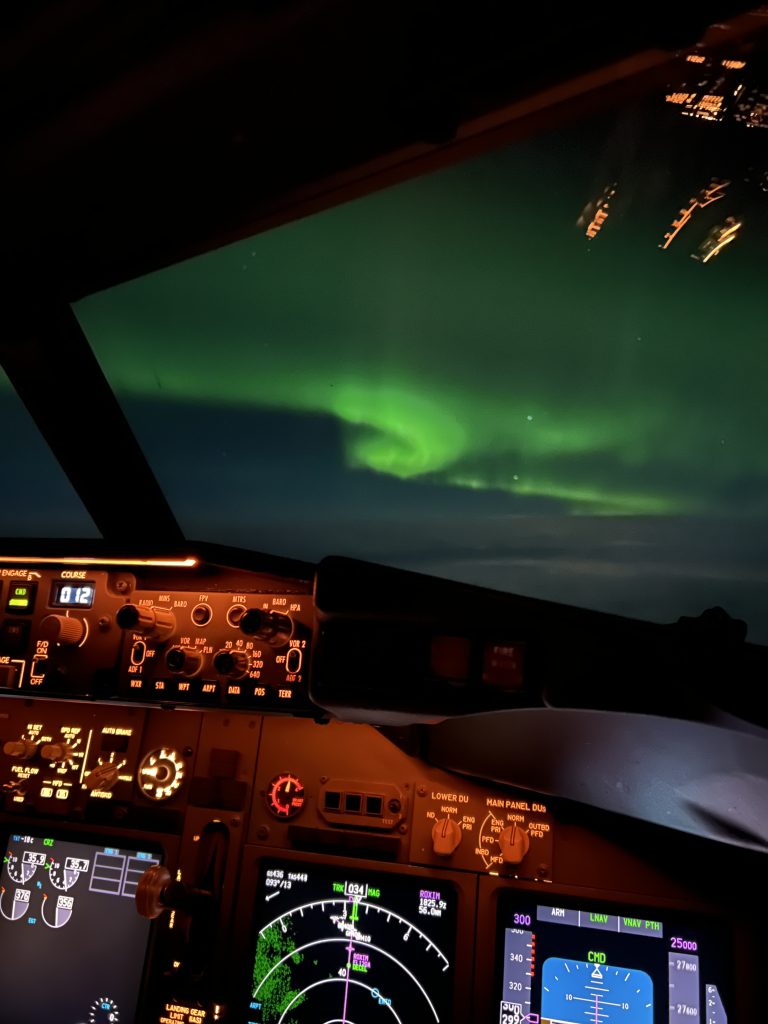
Monday 1st April 2024 to Sunday 30th June 2024. A grand total of 202 sectors flown for Ryanair equating to 685 hours and 25 minutes. These flights total a whopping 164,665 nautical miles flown which equates to 79.4% of the way to the moon, 45.9 times the length of the River Nile, or 191 times the length of the country of New Zealand! It’s been a brilliant few months flying to new destinations and those that are also familiar, as well as having some great experiences both in the flight deck and outside too that I can’t wait to share with you all. Of course it’s not all been smooth flowing and there have been some interesting things to tell you all in due course.
First, I’d like to bring up the numbers published by Ryanair on Monday 20th May 2024, and to say they’re impressive is an understatement that’s for sure! In the previous year, Ryanair increased passenger numbers from 168.6 million to 183.7 million – an increase of 9% (of those 183.7 million passengers, I’ve flown 0.0138% of them!) These passenger numbers are even more impressive when you consider they have increased by 23% since pre-pandemic levels. But Ryanair isn’t going to stop there, it’s projected for the current financial year to carry over 200 million passengers in a single year – that’s 549,450 passengers a day! Revenue has increased from €10.78 billion to €13.44 billion – a monumental increase of 24%; and arguably the most important of all, profit has increased by 34% from €1.43 billion to €1.92 billion.
All this is good news, and to bring even more good news, it’s forecasted that because of delays in delivering the Boeing 737’s on order, these numbers could’ve been even higher! With these increases in revenue and profit, it’s projected that Ryanair may lower its ticket prices making air travel even more affordable. All of the above is very good news, and it makes me proud to work for Europe’s largest airline.
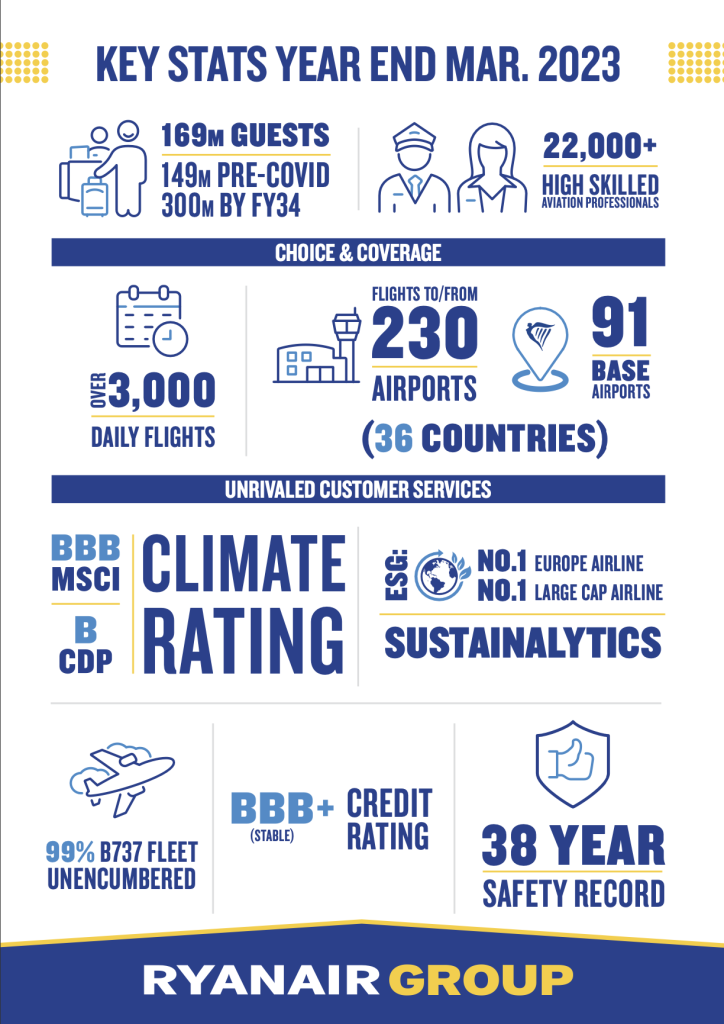
Following the good news of statistics, there were further figures published on 2nd July 2024, where Ryanair have broken yet another record. In the whole month of June, a whopping total of 19.3 million (19,300,000 to make the number seem even more impressive!) flew Ryanair in the month of June. In 30 days, Ryanair have flown the same number of passengers as just under the population of Chile and Kazakhstan (approximately 19.6 million people respectively) across the skies of Europe and Northern Africa. This huge number is enough to fill 102,116.4 Boeing 737-800 which is incredible! With the summer holidays just around the corner too, maybe this number can rise even further, especially as July and August both have 31 days!
April 2024
And now onto my own flight experiences! April brought about new destinations including flying within the U.K. much like how it was when I was completing my ME/IR training out of Cranfield – only this time I was flying a Boeing 737 with up to 189 paying passengers behind me! The flights were from London Stansted to Newquay, which as the crow flies is only 215 nautical miles meaning getting everything done is certainly a bit of a push for time given the block to block time (pushing back to on stand again) was as short as 55 minutes! Then there were the familiar airports in Marrakech and Tirana that I have now flown to quite a few times and I am slowly becoming more familiar with the routes, expected approaches and small nuances they each have.
On 17th April 2024 I had my second line check to make sure I was and am still safe to fly after completion of my line training in January. The flight was to Podgorica in Montenegro where the Captain flew down there and I was to fly us back. I should’ve known the way down there went a little too well, as in the skies above Germany we were asked to reduce our speed to Mach 0.73 or minimum speed whichever was slower (usually we cruise about Mach 0.77), when we enquired the reason, Stansted airport had closed temporarily due to a runway light breaking and subsequent repairs. However, when the runway re-opened, it wasn’t a case that we’d be able to come straight in, as Stansted was now facing a back-log of other aircraft also effected by the delay. So now on my first line check, I’m facing a possible diversion to another airport that I’m unfamiliar with… great! We began looking at how long we could hold for if needed at Stansted first; approximately 20 minutes. However, that 20 minutes was based on us going to Birmingham airport. Should we want to divert elsewhere that was further away such as London Gatwick or Birmingham then our holding time would reduce. Next we got the weather and began to formulate which airport was best to divert to; in this case East Midlands was the best case to divert to and we made our decision. Now, I briefed our descent, arrival, landing, taxi and aproach into London Stansted as well as what our diversion routing would be should we need to divert. Thankfully, approximately 20 minutes from London Stansted we were put onto radar vectors slightly delaying us and landed into London Stansted as planned. The passengers behind us, none the wiser! However, due to the closure, what was meant to be a short day for us ended up being a long day as the aircraft that was meant to go to Basel and back had to divert meaning we now operated the Basel flight instead. Good news for me; more flight hours and sector pay so I won’t complain! The whole day went well, and thankfully I am pleased to announce I passed my second line check, meaning I’m not due another line check for the very maximum of 1 year.
After the joys of the 17th April 2024, next was my day 5 of being on to operate Barcelona and back, then Carcassonne airport and back to finish. Barcelona went well, then Carcassonne had arguably the hardest approach to date, and as such it was Captains only. It was a steep approach and a short runway and when we got down there, the weather had made things worse. There was a large cumulonimbus cloud (CB) on the approach after being overhead the airfield. Using a combination of our own onboard weather radar and vectors from ATC we managed to get ourselves on the final approach. All the way down the approach it was turbulent and the Captain did a very good job on both the approach and landing and we landed safely. We turned around at the end of the runway and started back-tracking to then come off the runway and taxi to our stand. Both myself and the Captain looked at each other, both took a deep breath said two words, 4 letters long and 2 letters long respectively beginning with ‘F’ and ending with ‘me’ then laughed! The picture below was taken by a friend a few months prior (who has asked to remain nameless but has allowed me to use their photo) in Carcassonne while they were waiting for similar weather to dissipate with a CB on their take-off path.

After being cancelled back in February, I was due for my RST 4 training day. Like before I was sent to the East Midlands training centre for this where I was partnered up with another Ryanair UK captain based in Manchester. I find it amusing that when I first went into the sim back when I was in Ireland with AFTA, again with L3Harris in Bournemouth and my MCC at Gatwick, and finally when I started my type rating with Ryanair I would be more nervous than normal, unsure of what to expect and how I was going to deal with what was thrown at me. But now its become almost like a second home, things that are thrown at me, I deal with a lot better and thats all down to the preparation I put into it before I go into the sim and also the practice of being in the sim more frequently and being examined.
The training day went really well and both the captain I was partnered with and the instructor were great too which always makes things a lot easier. The training consisted of looking at winter operations as well as de-icing the aircraft before our departure. We started the engines using the crossbleed method then begun flying from Dublin to Manchester. Of course it wouldn’t be a simulator session if things didn’t go wrong so we had failures en-route and testing our knowledge of the systems onboard the aircraft. After a break we looked at bounced landing recoveries, tail strike avoidance – and what to do if we had a suspected tail strike – pilot incapacitation, and finally upsets to the aircraft and the necessary recoveries. Although I probably shouldn’t say this, it was actually really fun dealing with these failures! Don’t get me wrong, I hope they never happen on the line, but practicing these every 6 months in the sim is good fun.
Aside from the usual destinations flying in April, I also had another new experience, being a “sim body”. This is where I act as I’m told to act, do what I need to do in the sim while the other person is either training or assessed. I was a sim body for a captain who was coming back onto the line after being very unwell with the effects of Covid-19 and thus lost his class 1 medical. Following years of tests and examinations, he’s regained his class 1 and is now back in the sim ready to be flying on the line again. Although a new experience, I found this thoroughly enjoyable, and I’m glad I could help the captain in his training to getting back to work.
May 2024
My first flight in May saw me going back to Carcassonne in France, and after my last ordeal there, I can’t say I was too thrilled to see that on my roster! However, given I’m telling you about this, I’m pretty sure you can see where this is going! We flew down to Carcassonne knowing strong winds were forecast at our time of arrival, thus we took extra fuel in case of a go-around or diversion. En-route we looked at our performance and due to the short runway we elected to choose Flaps 40 for landing rather than 30 – this gave us less stopping distance, or more spare runway. On the approach the winds were strong, and the Captain again did well on the approach given the speed was fluctuating. However, to keep the speed under control it required large amounts of thrust changes. Upon landing the thrust input was rather high and the aircraft bounced with speedbrake deployment – this is a go-around, so that’s what we did. The go-around went as smoothly as these things can do and we entered a hold. To be less susceptible to the gusting winds, we chose to have another attempt but this time with Flaps 30. Again on the approach it was for sure a challenge, but again the Captain did very well and we landed in Carcassonne on our second attempt.
Within the same block as the go-around above, I also had a new first, all caused by my good friend Kyle based in Manchester who I completed all my training with. I woke up at around 04:30 due to operate a flight from Stansted to Fez, however overnight my roster had changed and I was now ferrying an empty aircraft from Stansted to Manchester and then bringing a different one back later on in the day. I say it was Kyle who caused this because he was flying an aircraft from Manchester to Lanzarote, and when they landed they had an issue that required the engineers to look at it, and the problem wasn’t signed off so he overnighted in Lanzarote. The next morning, they tried to correct the problem with no success and it took them the whole day to get the aircraft serviceable to fly back from Lanzarote to Manchester. As such, an aircraft was needed in Manchester to operate the flights for that day that Kyle’s aircraft was meant to do, hence why I flew it up to Manchester. I then had the day to myself in Manchester and spent a combination of walking round Manchester city centre, the Trafford Centre and napping! Meanwhile, Kyle was living the highlife in Lanzarote on a sun bed waiting for his aircraft to be fixed! I’m not saying I got the rough end of the stick here, but…
Once the aircraft had finished its flights for the day, myself and the Captain who took the aircraft up from Stansted, brought it back again in the very early hours of the morning the next day. I now have a new record for the shortest flight I’ve done, only 48 minutes from pushing back to on blocks again! However, I’d love to say this is where the fun stops. When we had got back to Stansted and got the latest weather, it was CAT III conditions due to fog over the runway. I would’ve given anything at that point to make this a simple and easy approach, but there we are! We set up and completed the CAT III approach to completion successfully and I was so ready for bed when I finally got back at around 04:30 in the morning, pretty much 24 hours after initially waking up!

There aren’t many more exciting stories to tell you about flying to be honest with you, but I do have a huge life achievement instead to share. On Thursday 9th May 2024, myself and my partner, Olivia bought and completed on our first property near to London Stansted airport at the age of only 23. We’ve settled in nicely, absolutely adore our first home and the surrounding area too given we’ve both moved away from our ‘home-towns’ and we’re both extremely happy with our achievement.
June 2024
June was filled with the usual destinations, as well as a couple of new stops in Essaouira Mogador, Rabat and Ibiza. It is always fun learning a new place and seeing different airport tarmacs than the same ones! This also included being called off standby to operate just Stansted to Edinburgh and back due to another crew experiencing large ATC slot restrictions. As we come into the summer months, delays are more inevitable caused by slots and ironically weather too. Very simply put, warm ground heats the air above it causing air to rise which creates clouds, and the way this occurs these can be big and nasty, especially over bodies of water such as the Adriatic, Aegean and Mediterranean Seas as well as the Bay of Biscay. As we go into summer, although this will be my first, speaking to various people, they all seem to be of the same consensus that there will be a few delays this summer due to things out of our control.
June also had another go-around, however this time I was the pilot flying. This is my first go-around that I was ‘responsible’ for, and I’m not ashamed to admit it. The retirement age for pilots in the U.K. is currently 65, so if I work until then, in the next 42 years of flying, this isn’t going to be the only one. However, what’s important is that I learn from what happened, see where I went wrong and improve both as a pilot and a person too. We were flying back from Marrakech airport to land at approximately midnight, due to delays out of our control it was slightly later, but nothing too severe. We got the latest weather which indicated no cloud and perfect visibility at Stansted. In my brief to the Captain, I said I may disconnect the autopilot early and fly us in if they were okay with this, to which they were. This is fairly regular, as at the end of the day, we’re pilots and we’re paid to fly and we want to fly, not let the automatics do it. However, when we got there, the cloud was actually broken at 700ft which startled both myself and the Captain. Once out of the cloud, I let the aircraft settle then disconnected the automatics. Upon doing so, I flew the aircraft down but my speed got a little low, I corrected by adding thrust. In the 737, when you add thrust to the engines which are located below the centre of gravity which is also behind the centre of pressure, this causes the nose to pitch upwards. Thus, when I added thrust I should push the nose down to combat this. I didn’t push the nose down hard enough. As such my rate of descent decreased and thus I was now high on the approach. I tried for the next 200-300ft to correct my mistake but the damage was already done. We then performed a go-around and landed successfully on the next attempt.
As I said before, I’ve learnt from what I did wrong here. I knew correlation between thrust and pitch attitude, that was one of the first things I was taught when I went into the 737 simulator before I joined Ryanair and it has been reiterated since then multiple times. I can use this first-hand experience however as a reminder in my head through my own eyes, how important this is. However, what I’d like to stress is that go-arounds are ‘normal’ and nothing to be scared of. I would much rather perform a go-around in the interests of safety if I wasn’t sure or unhappy with something, rather than push on into a potentially dangerous situation. An instructor I had at L3Harris for my MCC phase of training said something that has stuck with me ever since; “every approach is performed to a go-around, should you continue to land, then that is a bonus for the passengers.”
The month finished with taking some annual leave, which after the last couple of months I’ve had, I can say was definitely welcomed with open arms and was fantastic to finally have some time to unwind and relax. Alongside flying, being in and out the sim, some stressful and very long days, then on my days off having to work on my new home, to have some time just doing nothing, a bit of sightseeing and unwinding, it was more than appreciated!
Fear of Flying
As a pilot and it being part of my job, I can safely say that I’m not scared of flying… unless there was a spider in the flight deck, then we’ve got another issue! However, being in a relationship with someone who’s terrified of flying so much she grips my hand until all blood flow is cut off during take-off and her mum also scared to fly too. I’ve tried to explain in the past how safe it is, what the various noises are and what’s roughly going on at each stage of flight. So, in this discussion item with summer in full bloom and many people heading away on holiday, I thought I’d try to put some of the scary noises and stages of flight to bed.
Now the big thing that most people are scared of is turbulence so I’ll address this first and foremost. Turbulence is essentially where the air around the plane goes from being smooth to rough. Imagine water flowing from a hose, its smooth in the most part, but put your finger though the flow like a sprinkler and the flow is disrupted and becomes rough – thats the same with the air. This can be caused by many things, but the most likely are from changes in the wind speed, wind direction, air temperature or other aircraft and their wings disrupting the flow of air – think back to 2017 where a private jet got caught too close to an Airbus A380 which caused it to lose altitude. Thats an extreme example but points out what I’m trying to say. There have also been more news stories recently of passengers being killed by turbulence, for example flight SQ321 flying from London Heathrow to Singapore, diverted to Bangkok. Firstly, the death was due to a heart attack not the turbulence itself. But secondly, these things are going to be more well reported now we all have a phone in our hand. Even 20 years ago, we wouldn’t have wasted valuable film on the inside of a plane cabin. We’d save this for our destination. However, now we can, and do film everything, we’re more likely to see these videos appearing online and on social media.
Now, us pilots get to ‘predict’ turbulence before we fly. It’s presented to us in our weather packs where we can expect turbulence along route. We either try to avoid it the best we can, which may add some time onto your flight but ensure its smoother, or we put the seatbelt sign on to ensure passengers are seated and reduce the risk of injury caused by turbulence. We’ll also speak to ATC to see if we can climb, or more likely descend out of it. We tend to descend because we have larger margins between our high speed and low speed stall speeds at lower altitudes. However, just like trying to predict the U.K. weather and if the weather will be good at the weekend for a barbecue, we can’t make any promises or guarantees!
The best way that I’ve heard turbulence described as is to think of the air around the plane like a plate of jelly. Imagine you have a plate of jelly with a coin set in the middle of it. Without any outside interference, the coin will sit in the jelly and not move. However, if you come up to the plate of jelly and shake it backwards and forwards, up and down; the coin will move relative to the jelly, but once you stop shaking the plate, the coin will return to the exact same position as if you hadn’t shaken the plate… that’s turbulence! During turbulence, our aircrafts speed will fluctuate and our altitude may fluctuate a bit too – I’ve never seen it more than 20ft difference – and it feels like you’re in a washing machine. But when the turbulence stops, we return to where we were before as if nothing had happened; maybe you’ve spilt a little of your drink! I’ve heard other examples of water in a bottle being shaken but the same principle applies.

Next, I’m going to run through roughly each stage of flight and some of the sounds and feelings you experience and whats going on. Some of which I can’t account for and say for certain as they are different aircraft to what I fly. Equally some of which only happen on some flights and not others, that bashing feeling in the back of your seat is likely a child sitting behind you!
First, once all the doors are closed and you’ve heard the captain make their PA “cabin crew, arm slides and cross-check” and just before we start moving backwards as our pushback is commenced, it’ll sound like and feel that the air conditioning has stopped, or at very least not giving as much oomph as it was. On a plane, in the tail, there is a miniature turbine engine called an auxiliary power unit (APU) and 99 times out of 100 we use this to start the engine but using bleed air off this to spin the N2 turbine and start the engines. Rather than using this bleed air (usually we take this from the engines but can’t if they’re not started) for air conditioning we re-direct it to start the engines.
Shortly after the engines have been started, you may notice the lights in the cabin flicker briefly. Again, we usually use the generators on the engines to power the electrical system, but before they’re started we use the APU for this. That flicker of the lights is simply us pilots transferring the electrical system from being on the APU to being taken from the engines. You’ll then hear and feel the air-conditioning power back up, and that’s exactly the same as the electrical system; us pilots are simply transferring the air conditioning from being provided, or not provided for engine start, by the APU to being provided by the engines.
We’re then on the runway and the engines begin to spool up and my partner grips my hand so tight I never think I’m going to be able to feel my fingers again! You may notice the engines start winding up, then hold, then off they go, roaring as loud as they can as you power off down the runway. That little hold is us pilots again checking that things are working as they should. We advance the thrust to approximately 40%. The pilot monitoring ensures that the power is being supplied symmetrically and there are no abnormal indications or vibrations before we then press the take-off/go-around button and the thrust advances automatically to the require take-off thrust that we’ve calculated.
The next part that people don’t like or understand and the reason I lose even more blood flow to my hand is the so-called ‘sinking feeling’ after take-off. There are two types of departure regarding noise; noise abatement departure procedure (NADP) one or two. NADP 1 is when we accelerate and retract the flaps at 3,000ft above the ground level, and NADP 2 is when we accelerate and retract the flaps at 1,000ft above ground level. Now why the difference between the two? NADP 1 is intended to provide noise reduction for noise sensitive areas in close proximity to the runway, whereas NADP 2 is intended for noise sensitive areas that are further away from the runway. With NADP 1 we climb first then accelerate so get higher quicker, whereas NADP 2 the opposite is true.
I’d like you to assume some numbers, these aren’t true, but by making these numbers simpler, it makes things easier to understand. On take-off we climb at 100% power at 20º nose up resulting in 200kts indicated airspeed. Now, when we want to increase our speed to say 250kts so we can retract the flaps, we can’t add more thrust as we’re at 100% so a way of doing this is by lowering the nose to say 10º. This then causes the airspeed to rise and we retract the flaps on schedule. At this point, our rate of descent has slowed but is still positive; it’s gone from say 5,000ft/min to 2,500ft/min. This is that sinking feeling. Imagine accelerating as hard as you possibly can in a road car, when you change gear, your head goes from being pressed against the rear of the seat to nodding forward as if your braking. You’re not braking, but your acceleration rate has decreased.
When we get to cruise, some of the ‘issues’ passengers have are the fear of turbulence which I’ve explained above and also the various ‘dings and dongs’ that you hear in the cabin. Again, I can’t comment on other aircraft types, however I can say this about the Boeing 737. There are different noises used to signal who is calling who and also a visual signal at the called position:
- Fight check calling the cabin attendant has a pink call light and a two-tone chime,
- The cabin attendants calling us in the flight deck has a black light on our overhead panel and a single chime,
- The flight deck turning on the seat belts causes the seatbelt sign to illuminate with a single chime,
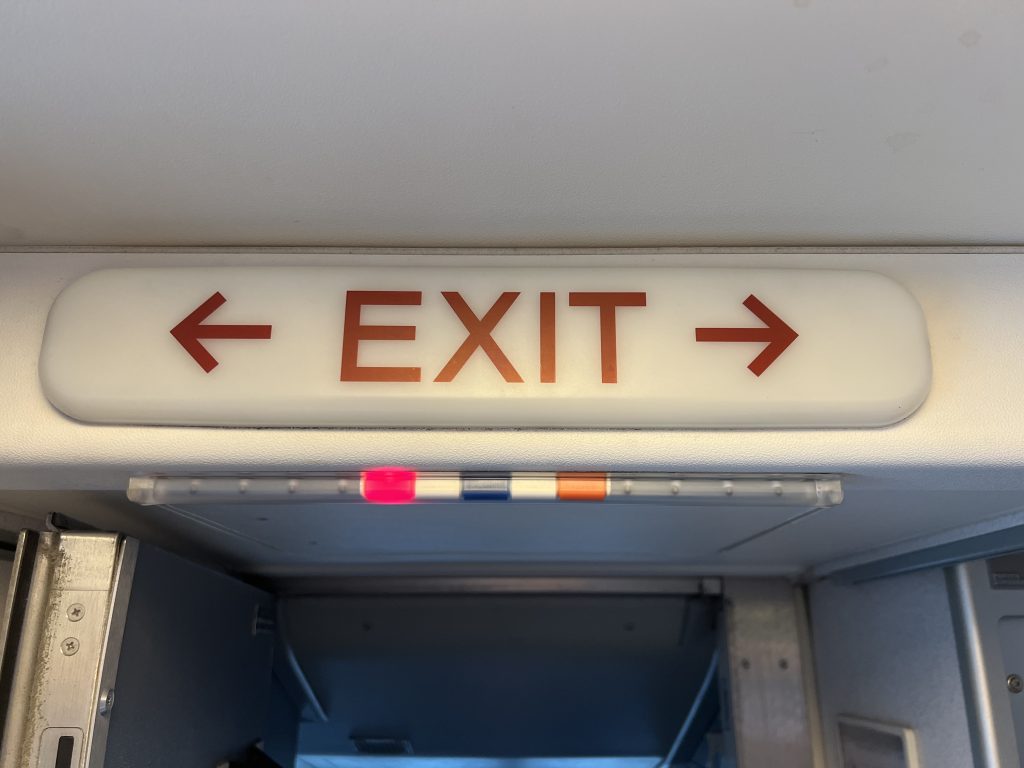
- When a passenger calls an attendant from their seat via the passenger service unit above their head, a blue light illuminates at the attendant station with a single chime,
- If the same call is made from a toilet however, the light is amber with a single chime.
The picture below was taken pre-flight when I tested our attendant call switch.
Next we have the descent. We’ve been cruising along for however long the flight is, you’ve had any food or drinks, been offered to buy any last duty free and offered a scratch card onboard a Ryanair flight. The attendants have come through to collect any rubbish and you’ve binged your downloaded series on your phone and now playing candy crush! We’ve now begun our descent into your destination, and you can almost smell the suncream and taste the local beer.
People I speak to who are afraid of flying aren’t necessarily scared of what’s happening, but more the statistics which say the most likely time for a crash is during the approach and landing. However, this stage is heavily briefed between us pilots, we’re both on high alert monitoring not only the aircraft, but also each other too. It’s imperative we both understand what’s going on, what the next actions are, and what we expect to happen next too; we use the phrase “being ahead of the aircraft”.
Finally we have the landing, and yes this can be scary, especially if a go-around is performed. However, from what I’ve said above and will reiterate, go-arounds are safe and they are also fairly standard too. Before every approach we will brief the go-around and our actions as a crew should we need to go around which typically will go something like this; “Should we need to go-around the call will be ‘go-around, Flaps 15, set go-around thrust’, push the TO/GA switch. At a positive rate of climb we’ll raise the landing gear. At 400ft, verify LNAV (or heading select as required) and tune the radios for the missed approach. The aircraft will start to accelerate at 1,000ft AAL and we’ll retract the flaps on schedule. Once level with the flaps up and no lights, we’ll select level change, max continuous thrust, re-engage the automatics, climb to above the MSA and complete the after take-off checklist.” This is briefed before every approach, so given I’ve done 202 flights for Ryanair, I’d have given or heard this brief at least 202 times on the line, plus many more times in the simulator also.
The main message here is that flying is safe. It does go wrong from time to time because we’re humans and we all make mistakes – that’s human nature. As much as you may not want to admit it, you would’ve made several mistakes today, as would everyone you walk past in the street. Granted most are minuscule and don’t have an effect on our lives! However unlike other professions and industries, the aviation industry is set up to learn from our mistakes to avoid the same thing happening twice. A Captain I flew with who has since retired used to say in his PA before landing, “when we land you would’ve completed the safest part of your journey so please do take care when getting to your final destination” and that’s very true.
Now if I’ve missed anything or you’d like me to clarify some issues to help with your fear of flying, please do get in touch via any of my social media channels or via the get in touch function here on my blog.