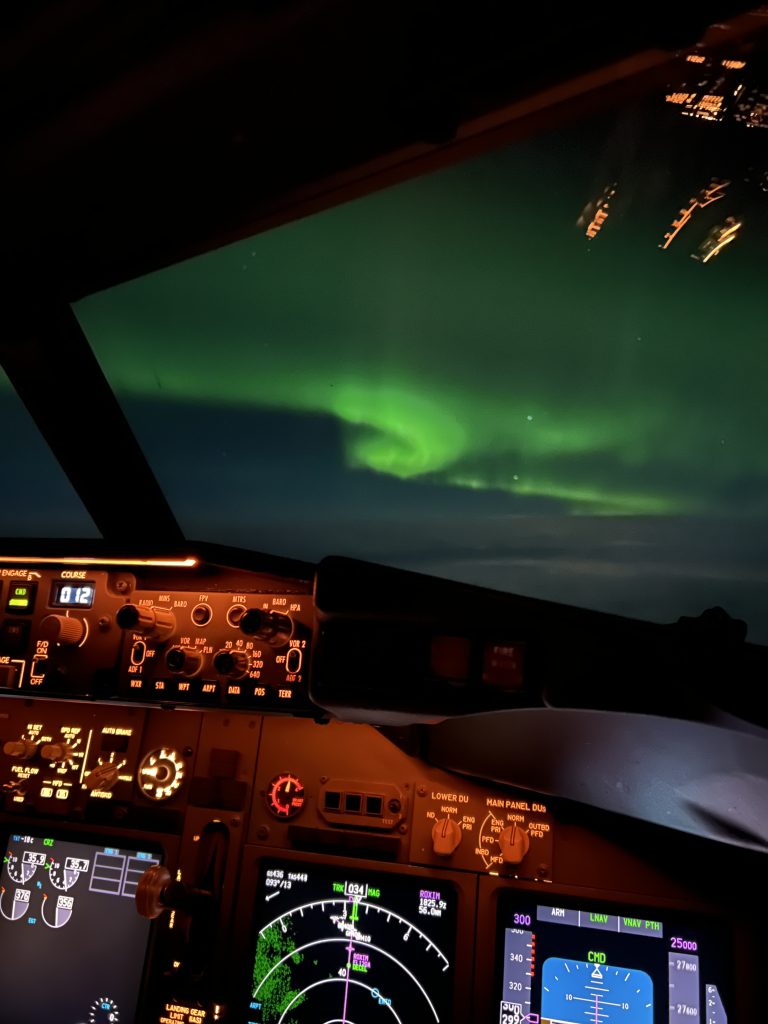
Sunday 1st October 2023 to Tuesday 31st October 2023. Sectors 25 to 44, 89 hours 56 minutes line training flight time; total distance of 27,867 nautical miles which equates to 13.4% of the way to the moon, or up and down the length of New Zealand 32.4 times. I have carried a total of 6,588 passengers which equates to nearly double the population of the Falkland Islands! This months I’ve been flying out of two airports, my base Leeds Bradford and also Stansted airport too on an out of base – I’ll mention this more in a bit. Once I’ve given a bit of round up on my flights, I’m going to bring you my first discussion item, and this time its all about the autopilot on the Boeing 737!
Before I get started, I’m going to mention very briefly the TUI aircraft that news reports are saying has ‘skidded off the runway’. Now, I’m not going to speculate on what happened here as I wasn’t in the flight deck so I don’t know, all I am going to say is that myself and everyone I’ve spoken to about the indecent has said that so long as everyone is okay is the main thing. In Leeds I have seen the now very muddy TUI aircraft and I have also seen tyre marks in the grass where it ultimately came to a standstill. We will have to wait for what the investigation says happened and if we can learn from what happened to ensure it’s unlikely to happen again. It’s also to be said that members of the public speculating about the incident isn’t helping matters, and it would be better for everyone involved if we didn’t speculate until the final report is published.
Sunday 1st October to Sunday 8th October 2023
The month began flying out of Leeds to Palma De Mallorca and Alicante; both of which I’m starting to becoming familiar with after flying in/out of there a few times. Equally, it’s nice having a few minutes in the Spanish sunshine to complete the walk around. It also taught me to be a bit more considerate to other pilots in the air. When we were coming into Alicante, we were number 1 for the approach, the STAR (standard arrival) follows an arc before intercepting the final approach track at about 15-17nm. Once we intercepted the final approach track, I wanted to start configuring flaps 1 and flaps 5, however there was another Ryanair aircraft behind us as number 2 for the approach. I asked for flaps 1 but the Line Training Captain questioned whether it was the right time due to traffic behind, I realised what he meant and delayed – still configured to flaps 5 by 10nm as per our SOP’s. We then discussed this on the way home about being considerate to others and ensuring we’re aware of not only whats in front of us and for us to come next, but all behind and what they’ll also be doing.
Monday 9th October to Thursday 12th October 2023 – Out of base at Stansted airport
As mentioned at the top, I was assigned an out of base at London Stansted Airport, flying for 3 days out of the airport that I would like to be based at come the end of my line training. Day 1 started completely different to anything I’ve ever seen before! I was scheduled for 4 sectors, once I got through security, my first 2 flights had been removed, all that was left was the last 2. Then 5 minutes later the next 2 were removed also. Myself and the Captain began to head back home/to the hotel, when I thought I’d check once more, and then we had another 4 flights showing to take off in 20 minutes time. We knew we were going to be late as it was so the whole day was playing catch up on the time we’d lost.
The other two days went smoothly and I didn’t have last minute changes like before! One of the benefits of Stansted that it’s miles busier than Leeds meaning everything I had to do on the radio had to be so much quicker, my descents were radar vectored by ATC and were required to be a constant descent approach as opposed to levelling off. All of this combined I believe has made me a better pilot and definitely helped with my descent management which I have previously been struggling with.
Friday 13th October to Tuesday 31st October 2023
I finish the month with flights to Dublin, the sort hop across the Irish Sea where pretty much as soon as we’re up we’re back down again, Palma De Mallorca and Krakow, a destination I previously hadn’t been to so was good to get into there. The views were stunning as we came in, and my descent management was good, looking ahead and thinking whats coming next without prompts.

Discussion Item – Autopilot
“You just sit there while the autopilot does all the work!” “How much do you actually fly?” “Just press a button and it does the take-off and landing all by itself!” “With the autopilot do you really need two pilots?” These are some of the phrases that I hear on a weekly basis regarding the autopilot, and to an extent some of them are true, but equally they couldn’t be further from the truth. I’ll begin by taking you through the various modes of the Boeing 737 autopilot system as this is different to other types of aircraft.
There are various levels of automation, ranging from higher levels so the aircraft is doing more work and the pilots are doing less work, to lower levels of automation where the aircraft is doing less work and the pilots are doing more work. If understood and operated in the correct manner, it is therefore safer to be in a higher level of automation. The aircraft has different modes based on what you want it to do, whether this be lateral so routing, or vertical so up and down.
There are 2 ‘master’ autopilot modes, CMD or command A & B, and also CWS or control wheel steering A & B. On the line, I am yet to use control wheel steering and have only used command. Command is where the aircraft will use the mode selected to fly the aircraft – a way of thinking of it, is you’re giving command to the aircraft. Control wheel steering on the other hand is essentially putting it into Airbus mode! In an Airbus with a side stick, if you pull back to 10º nose up and let go, an Airbus will hold the pitch attitude at 10º until another input is made – this is my understanding from when I completed my APS MCC in the Airbus A320-200, I don’t know an Airbus inside out! Control wheel steering in the Boeing 737 replicates this. So if I was to pitch up to 10º in control wheel steering and let go, the aircraft will hold this attitude, the same goes for roll modes too. If I was to roll the aircraft into a 20º angle of bank turn in control wheel steering and let go, the aircraft will hold a 20º roll.
Lateral modes of navigation on the Boeing 737 include: LNAV, VOR LOC & HDG SEL. LNAV is the highest level of automation. We program the Flight Management Computer (FMC) as part of our pre-flight checks. In these checks, among a lot more, we enter our origin, destination, flight number, standard instrument departure (SID), standard arrival (STAR) and the waypoints along the route to form one long line from departure to destination runways. When we’re operating in LNAV which stands for lateral navigation, the autopilot follows the route that we’ve put into the FMC. During flight, we are able to modify the route by bringing later waypoints forwards – effectively getting a shortcut, or move points around so we get a route that complies with new ATC instructions. In this mode, the aircraft will ‘plot along’ from point to point without the pilots intervention; therefore as you can imagine we use this mode wherever possible.
VOR LOC which means VOR (Very high frequency Omnidirectional Radio range) a piece of equipment that produces ‘radials’ that us pilots can follow to or from a station. And LOC stands for localiser, essentially, a beam that is produced from the arrival end of the runway that pilots/aircraft can follow to the threshold of the runway when going into land. For the sake of ease, think of a localiser as one radial produced from a VOR and is much more accurate. In this mode, as I’ve already alluded to, it allows us to follow a radial to or from somewhere. A typical example of when we’d use this mode is when we’re cleared by ATC to intercept the localiser only for our approach. If the ground navigation equipment that we’re using on our route is a VOR, for example, MCT (a VOR at Manchester airport) we could use this mode to track to it. However, in this scenario its more accurate for us to use LNAV to track to the waypoint.
Finally we have HDG SEL, meaning heading select. This is the lowest form of lateral mode navigation where the aircraft simply follows a heading. For example, if we were tracking to a waypoint with an approximate heading of 340º, ATC may ask us to start a turn early or route slightly different due to other traffic and give us a heading of 350º to fly, we select the heading we are told to fly, press heading select and the aircraft will fly this new heading indefinitely, regardless of what we’ve pre-programmed in the FMC.

Next we have the vertical modes of navigation; VNAV LVL CHG V/S. VNAV is the highest mode of automation and again is the preferred mode in Ryanair and stands for vertical navigation. This follows a path designed by the FMC using entered altitude constraints to ensure we’re on profile – namely for our descent, but also for our climb too. We still need to request descent from ATC, and we still need to meet their restrictions, but in VNAV, it will help us to make the restrictions placed on us, provided they’ve been entered correctly. VNAV is a great mode, providing two things; a) it’s been set up correctly in the FMC to begin with, if it is entered wrong then the aircraft will want to follow the wrong path, and b) and arguable the most important, the pilots understand what version of VNAV we’re in and the aircraft is doing what we want it to do.
The next mode is LVL CHG standing for level change. When we enter a new altitude, in level change, the aircraft will pitch to match the speed entered and then climb at whatever rate this speed gives us. In a climb, a higher speed will result in a lower rate of climb and a lower speed will result in a higher rate of climb; conversely in a descent, a lower speed will result in a lower rate of descent and a higher speed will result in a. Higher rate of descent. We can use this to manipulate our profile – in a climb, if we need to climb fast, we’ll select a lower speed, climb quickly and meet the restriction; or most likely in a descent, if we’re left high, we’ll increase the speed to get the aircraft down quicker. This is a generalisation, but us pilots like to be low and slow earlier as it makes our lives easier, but ATC want us high and fast as it makes their lives easier. So quite often in a descent, we’ll be in level change to get us down quicker than what VNAV would want.
Finally, we have V/S or vertical speed; or as I was told in flight school very stupid mode! Vertical speed pitches the aircraft for a set vertical speed in feet per minute. After what I’ve just said you may think that we hardly use it, but quite the opposite, when we’re climbing or descending we have a three, two, one rule where when we’re 3,000ft to go to our level off altitude, we select a vertical speed of 3,000ft/min, at 2,000ft to go we select a vertical speed of 2,000ft/min and as you can imagine at 1,000ft to go, we select a vertical speed of 1,000ft/min. We use this rule to ensure we’re not tearing up or down to an altitude, and risk setting off either our own or another aircrafts traffic avoidance collision system (TCAS).
So they’re the various modes of autopilot that we have available to us and can use at any given moment in flight. However what I think I’ve made quite clear is that the pilots have to control what mode we’re in and then closely monitor to ensure it’s behaving how we want it to. Equally, if we enter rubbish into the system we’re going to get rubbish out of it. Therefore, and I cannot stress this highly enough it is essential everything is done correctly in the first place and then monitored closely. Therefore in answer to the first question where we just sit there. Yes, autopilot reduces our workload and can increase our capacity for other tasks, it still needs to be constantly monitored.
In Ryanair it is standard procedure to engage the autopilot after take-off at 1,000ft above ground level. So yes, this means everything up until that point is done by us pilots – the plane cannot take off by itself on its own. From autopilot engagement we will leave the autopilot in until it comes to disconnecting it for landing. At the end of the day, we’re pilots, we love flying so will always want to fly and especially land the aircraft. However, we do have the option to autoland the aircraft, but the procedures we have to do are a lot longer so we typically will only do this when the weather doesn’t allow us to land ourselves.

Finally, a bit of a controversial point, do we need two pilots. I will always say yes, namely because it keeps me in a job! However, when it comes to safety, I don’t think there is really any question. Can we do everything on our own in the flight deck? Simply put, yes. We practiced pilot incapacitation in the simulator at the busiest times of flight, however I did look like the scene from Airplane! by the time I was done and dripping in sweat! Two pilots means we share the workload and when it comes to decision making, we can bounce ideas off each other. Autopilot means we increase our capacity, but we still need 2 pilots in the flight deck in my opinion. I’m aware there are tests ongoing all the time whether we need 2 pilots, and I think it’s always going to come down to a battle between accountants and safety. I understand the argument that where do you stop with the number of pilots in the flight deck, if one can’t fly then the other faces the same chances too. However, looking online at statistics, pilot incapacitation occurs approximately 0.037 times per 100,000 hours – this doesn’t mean dying, it just means unable to fulfil their duties such as suffering from gastroenteritis. I can think of only 1 example where a flight has suffered with both pilots becoming incapacitated – Helios Airways Flight 552 where both pilots are suspected to have suffered with hypoxia so the chances are very slim.